Published the 02/19/2026 in Exploring the Region
Many travelers view the Charente and Charente-Maritime regions through a single lens: either the prestigious distilleries of Cognac or the sun-bleached shores of Île de Ré. However, to treat these as separate destinations is to miss the true soul of the French Atlantic. At My Private French Travel, we approach this territory as a fluid journey. The real magic happens in the transition—where the limestone soils of the vineyards meet the salt-sprayed ramparts of the coast.
The Charentes is not a "fast" destination. It is a region of maritime history, architectural prowess, and culinary traditions that date back centuries. Whether you arrive via the TGV in Angoulême or drive up from the Bordeaux vineyards, the shift in light and pace is immediate.
Accessing the Charentes is a matter of strategic choice. For those coming from Paris, the high-speed TGV to Angoulême serves as the perfect "land" entry. Perched on a rocky outcrop, this city of art and history offers a vertical contrast to the horizontal plains that follow.
Alternatively, many of our guests choose to start in Bordeaux. It is a seamless transition; as we drive north, the gravelly soils of the Médoc give way to the "Groies" (calcareous clay) of the Charentes. This route allows us to trace the path of the Charente River—the "most beautiful stream in the kingdom"—which acted as the historical highway for transporting salt, stone, and spirits.
To understand the Charentes, one must understand Cognac. But forget the corporate tasting rooms. Romain and I prefer the intimacy of the Bouilleur de Cru (the craft distiller).
If you visit between November and March, you witness the "Part des Anges" (the Angel’s Share) in a visceral way. This is the distillation season. The air in the distilleries is thick, warm, and scented with heady vapors of pressed grapes and wood. We arrange for our guests to meet the master distillers when the copper alambics are roaring. There is a specific technicality to this—the double distillation process—that requires a quiet, focused expertise. Watching the "heart" of the spirit emerge is a lesson in patience.
While the monuments and landscapes of the Charentes are open to all, the soul of the region remains behind closed doors. Here is how we open them for you through our private network.
The "Paradis" is the most sacred part of a Cognac cellar, where the oldest eaux-de-vie—some dating back to the 19th century—are kept in glass demijohns. For a truly singular evening, I privatize a family-owned estate’s cellar for a gala dinner served entirely by candlelight. There is no electricity here, only the soft flicker of wax reflecting off century-old oak. Surrounded by the "black mold" (Torula compniacensis) that proves the evaporation of the spirit, you will enjoy a multi-course menu designed to pair with various ages of Cognac. It is a sensory journey that defies the modern world.
In La Rochelle, the relationship between the chef and the ocean is not transactional; it is symbiotic. We arrange for our guests to join a renowned Michelin-starred chef—a master of maritime gastronomy—on his private boat at dawn. This is not a "tour." It is a technical masterclass in sustainable sourcing. You will learn to identify the Demoiselles de Rochefort (langoustines) and understand the influence of the tides on flavor. The morning concludes with a "crudo" preparation on deck, using the catch of the hour, paired with a crisp Charentais white wine.
For our Family Office clients or high-level corporate incentives, we transform the Pertuis d'Antioche into a private stadium. We organize bespoke sailing regattas from La Rochelle to discover the islands of Oléron, Aix and Ré.
The Competition: A structured race passing the stone walls of Fort Boyard, with professional skippers guiding your teams through the tactical maneuvers of the Atlantic.
The Leisure: A "flotilla" experience where several boats sail in formation to a secluded sandbar only accessible at low tide for a luxury picnic.

Rochefort is a city built by design. Founded by Colbert for Louis XIV, it was intended to be the most beautiful naval arsenal in the world.
The Corderie Royale: Walking the 374-meter-long Royal Ropery, you smell the hemp and the tar—the scents of 17th-century global ambition.
The Transporter Bridge: A true architectural marvel designed by Ferdinand Arnodin, an associate of the school of Gustave Eiffel. Crossing the Charente suspended in its gondola provides a perspective on the river's scale that you cannot get from a car.
La Rochelle is the Atlantic’s defiant heart. Its two towers guarding the Old Port are iconic, but the real soul lies in the "Vieux Marché."
For the foodie, gastronomy here is defined by Christopher Coutanceau. His three-Michelin-starred restaurant is a temple to the sea. He doesn't just cook fish; he advocates for "zero waste" and sustainable fishing.
Local Culinary Traditions from the ocean:
L’Éclade de Moules: A ritual where mussels are arranged in a precise spiral on a wooden board and covered with pine needles, which are then set ablaze.
Huitres Marennes Oléron: These oysters are finished in "claires" (shallow clay ponds), giving them a unique green tint and a nutty finish.
One cannot discuss the Charentes without mentioning the "white gold"—the sea salt harvested from the salt pans of Île de Ré and Oléron. This salt is the backbone of the region's confectionery. The local Fleur de Sel is folded into artisanal caramels and is the essential ingredient in the legendary Galette Charentaise.
Crucial to these flavors is the Charentes-Poitou AOP Butter. Its subtle nutty profile and high plasticity (due to the slow fermentation of the cream) make it the favorite of France’s top pastry chefs. I often take my guests to small-scale producers where the traditional "Baratte" (churn) is still used. Tasting a traditional sea-salt shortbread or a "Broyé du Poitou" made with this AOP butter, alongside a local coffee or a glass of Pineau des Charentes, is a simple but profound regional rite of passage.

The choice of island depends entirely on the desired "vibe."
Île de Ré: High-end, polished, and best explored via the "Flow Vélo" paths. We recommend the Vauban fortifications in Saint-Martin-de-Ré, a UNESCO World Heritage site, for a sunset walk on the ramparts.
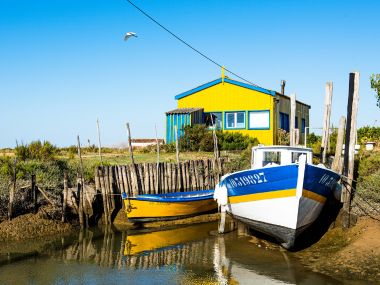
Île d’Oléron: The "wild child." It is larger, more forested, and feels more authentic. The oyster huts here are painted in vibrant primary colors, and the surfing on the Atlantic side is world-class. Did you know that Fort Boyard is located there? Take a boat ride to see it from the outside (and visit it from 2027 onward).
Moving through the region: While a rental car offers freedom, the Charentes is can also be experienced with a private chauffeur. This allows for vertical tastings in Cognac without concern. For larger groups, we utilize luxury mini-coaches or executive vans to ensure continuity of service from the vineyards to the coast.
For those who wish to feel the wind of the Atlantic and the calm of the valley, we have mastered the logistics of the Flow Vélo. This scenic cycle route links the heart of the vineyards to the ocean. We curate multi-day e-bike itineraries that allow you to traverse the rolling hills of the Charente at your own pace without the physical strain.
Our logistical support is what makes this "seamless": we manage the luggage transfers between luxury properties, provide top-tier electric bikes with GPS-mapped routes of the most scenic backroads, and have a support vehicle on standby for any technical needs. Imagine cycling through the vines in the morning, stopping for a private picnic in a Romanesque abbey, and arriving in Rochefort or La Rochelle just as the sun begins to set over the masts.
When to visit? Avoid July and August for the oceanside and the islands, it is very crowded. We can suggest an adapted itinerary for july.
September/October: The light is golden, the water is warm, and the grape harvest begins. Great for surfing.
Winter: Ideal for the "Cognac experience" and having the La Rochelle towers all to yourself.
Are there UNESCO World Heritage sites in the Charentes? Yes. Key sites include the Vauban Fortifications in Saint-Martin-de-Ré and stops along the Routes of Santiago de Compostela, such as the Abbaye aux Dames in Saintes.
Is it possible to visit Fort Boyard? Currently, the interior of the fort is closed to the public as it remains a working television set. However, a major restoration project is underway; it is anticipated that the fort may finally open its doors to visitors by 2027. For now, we arrange private catamaran charters to sail alongside its massive stone walls to appreciate its scale from the waterline.
Which season is best to avoid the crowds? We recommend May/June or September/October. However, for those interested in the technical aspects of spirits, the "distillation window" from November to March offers an exclusive, cozy atmosphere.
How do we navigate between the vineyards and the islands? The drive from Cognac to La Rochelle is approximately 1 hour and 15 minutes. We typically structure itineraries to spend 2-3 days in the "land" (Cognac) followed by 3-4 days on the "water" (La Rochelle/Islands).
To design your bespoke journey from the Charente vineyards to the Atlantic islands, contact Cyrielle at My Private French Travel. We curate the logistics so you can focus on the light, the salt, and the spirit.